Enso
The world is not one world. Fungi that break down wood so that a forest can begin again become agents of a cycle in which growth and decay are phases of a single movement. The resulting forms grow out of this behaviour rather than being drawn in advance, belonging to a world already unfolding alongside our own.
Concept
Enso is a speculative series built with white-rot fungus, lignin and a microbial growth medium. White-rot fungi are among the few organisms capable of breaking lignin down, taking a fallen tree apart so that its material can return to the forest floor. The series treats decay as a working material: the pieces are printed into form and then left to continue changing.
The work does not set out to picture another world so much as to build small pieces of one. Fungal structures set the geometry, a growth model carries it forward through time, and the resulting objects appear as furniture from a forest that keeps its own terms. They are proposals for such a world, rather than predictions of its future.
The series
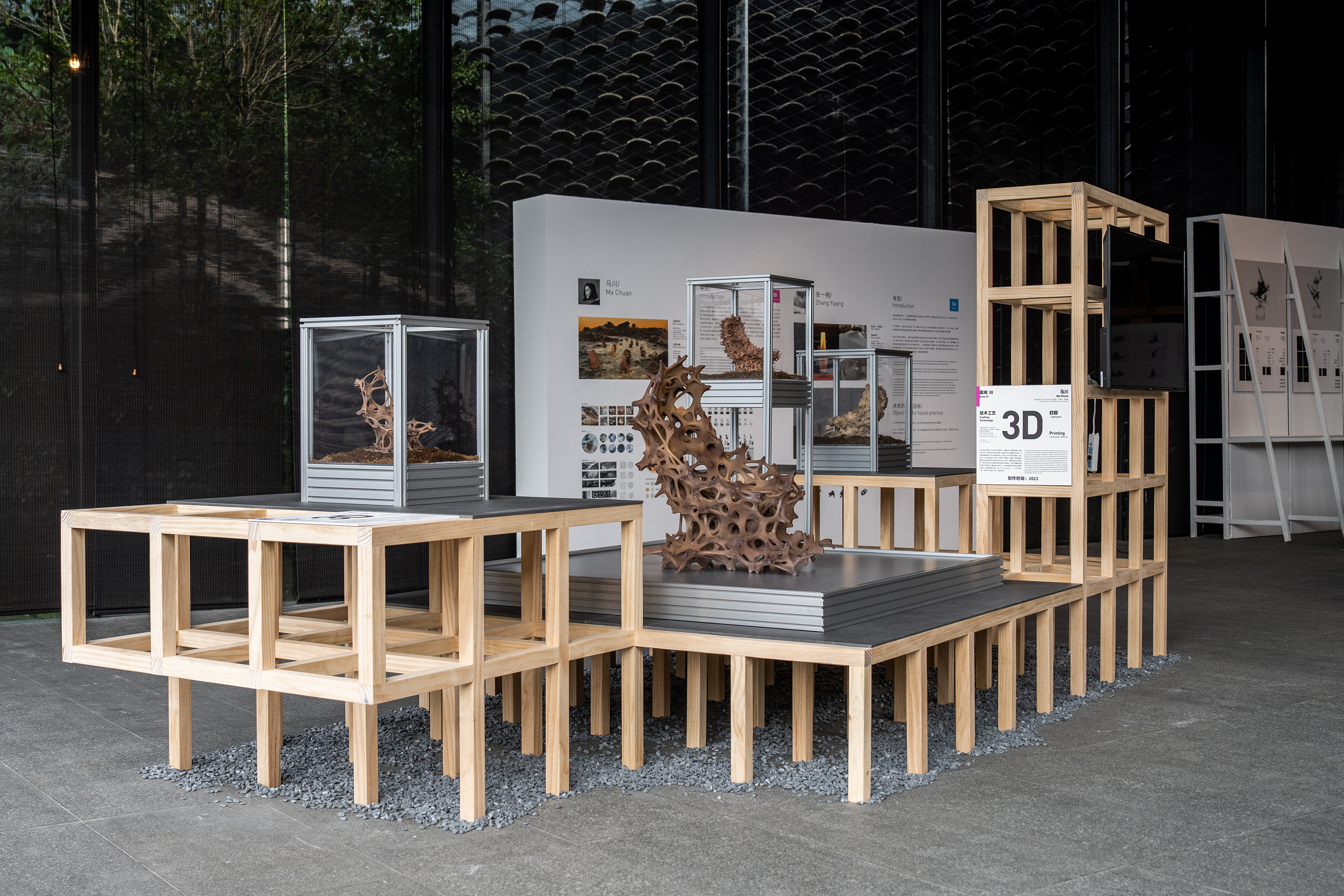
Enso II is a group of four seats grown from one system: fungal structure, run through a growth model, printed in a biomaterial that keeps decaying. Each holds a different result of the same process.
What follows is how they were arrived at, from the fungus itself through to the printed form.
White rot
White-rot fungi feed by breaking down lignin, the stiff polymer that holds a plant upright. In a forest this is how a fallen tree is taken apart and returned to the soil, one of the oldest exchanges between fungi and plants. The project works with that breakdown as a way of making, not only of undoing.
Under the microscope the fungus resolves into hyphae: fine tubes, straight or curved, that branch irregularly and rejoin through clamp connections. In wood they pass from one cell to the next through the open lumen, through the pit openings in the cell wall, or by boring straight through it. These few behaviours, the tube, the branch, the join, the spread across a boundary, are the vocabulary the forms are built from.
The circle
To watch the fungus feed, a Congo red medium is mixed with lignin in a fixed ratio and set in dishes. White-rot fungus is placed at the centre, as a pure culture or carried in on a piece of colonised wood. As it consumes the lignin the red clears around it, leaving a pale circle that widens with time. That circle is the enso: a direct reading of how far, and how evenly, the fungus has eaten.
Different strains and feeding rates leave different circles. Some clear a clean disc, some a broken or lobed edge, some a dense mat of growth holding the centre. The plates are the first measurements the rest of the project works from.
Biological translation
The hyphal structure seen in the cross section and radial section of the wood is reduced to a set of directional nodes. This is where a biological image becomes something a model can run: the branching and the joins are kept, everything else is dropped. The node values then drive an iterative deformation, each pass reshaping the last, with a parameterised matrix setting how the whole form grows outward.
Time is part of the model, so what it produces is a growth history rather than a fixed shape, with lignin degradation carried alongside the growth. Running the same framework with different values gives a family of forms rather than one design. The transparent, wood-like outlines it settles on are taken straight into fabrication. The chairs are those outlines, printed.
Material and print
The printing material is a wet mix of cellulose, sodium alginate and pectin, roughly 50 / 30 / 15 by the first recipe and 60 / 20 / 15 by the second, carrying lignin and a microbial medium. It is extruded layer by layer into the generated forms and left to set.
The set pieces are then inoculated with white-rot fungus. Decay does not stop when the object leaves the printer: the material keeps breaking down slowly wherever it is kept, responding to the humidity and light around it. Each piece is closer to a stage in a process than a finished state.
Enso I, II, III
The series is shown as three works. Enso I is a low disc, 800 millimetres across and 120 high. Enso II is the group of four seats, each about 280 by 290 by 310. Enso III is a single larger form, 800 by 830 by 680, closest to a chair.
Set together they read as furniture from a forest that keeps its own time, each piece holding a version of that world. The series was first shown in 2023 at the China Folk Art Museum, in New Perception of Technology, an international handicraft experiment exhibition.
Credits
Artist: Ma Chuan
Team: Kuang Lanyu, Kuang Weixi, Liang Junpeng
Media: biosynthetic material (lignin, white-rot fungus, microbial culture medium); 3D printed
Dimensions: Enso I Ø800 × 120 mm; Enso II 280 × 290 × 310 mm, four pieces; Enso III 800 × 830 × 680 mm
Year: 2023
Exhibition: China Folk Art Museum, New Perception of Technology: Contemporary International Handicraft Experiment Exhibition